Best Platforms to Build and Promote an eCommerce Website in 2023
If you’ve been thinking about what eCommerce platform to choose for your online store, you’ve probably noticed that the choice is extremely wide.
The market seems to be bursting with various solutions – from well-known SAAS platforms and CMS to some less obvious, yet highly rated options. So, how do you know which online store platform is right for you?
That’s exactly what we’re going to talk about in this article – what the best e-commerce platforms are out there and which one you should choose for your online store in 2023.
What Is an eCommerce Platform?
There are two answers to the “What is an e-commerce platform” question. The first one states: an e-commerce platform is a type of website that allows businesses to sell products and services online. It typically features a set of tools that enables a business owner to:
- create and publish an online store
- process payments
- manage inventory
- handle shipping and order fulfillment.
The second e-commerce platform definition is a simpler one: an eCommerce platform is an online service that has everything you need to sell your products/services on the Internet.
E-commerce platforms come in different types and sizes, ranging from simple website builders to complex enterprise-level solutions.
Things to Consider When Choosing a Platform for E-commerce Website
When it comes to launching and managing your online store, choosing the right platform for an ecommerce website is crucial – and for a good reason (a few, actually).
The platform you choose will determine the functionality, scalability, and overall success of your online store. With so many website ecommerce platforms available, it can be overwhelming to decide which one is the best online ecommerce platform for your business.
Here are some things to consider:
- Cost
Consider the cost of the platform and its maintenance, including any monthly fees, transaction fees, and add-on costs.
- Ease of use
Choose a platform that’s easy to use and has a user-friendly interface (this ease of use, however, should not come at the cost of point 7 of this list).
- Customization
Look for a platform that allows you to customize your website to fit your brand and business needs.
- Security & reliability
Look for a platform that offers robust security features to protect your customers' data and your business (such as SSL encryption, PCI compliance, and fraud detection).
- Payment options
Consider the payment options available on the platform and whether they are suitable for your business.
- Scalability
Pick a platform that can grow with your business and handle increased traffic and sales.
- Features and functionality
Make sure the platform offers a wide range of features to manage products and orders from the box as well as plugins and 3rd party marketing services integration.
Best eCommerce Platforms to Build and Promote Your Online Shop in 2023
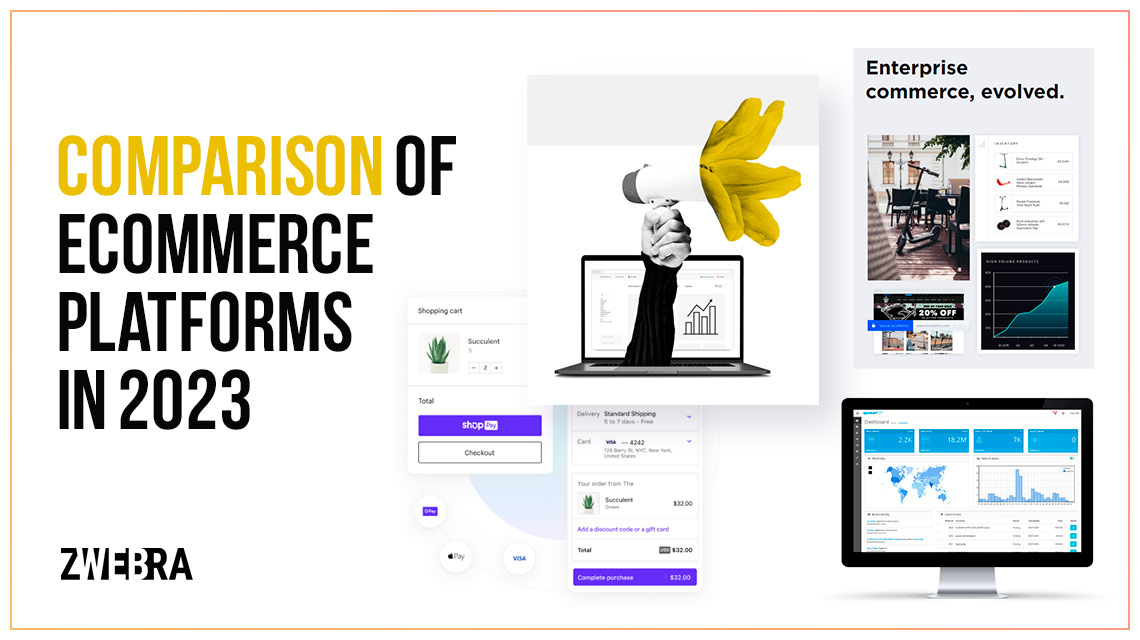
If you’re going for a well-known, easily customizable ecommerce platform, your choice basically boils down to the “Big Four” – Shopify, BigCommerce, Open Cart, and Drupal. These are all established brands, with hundreds of thousands of users globally. It's worth mentioning that the majority of eCommerce platforms are already making big steps in offering AI-powered tools. Learn more about AI in eCommerce in our blog.
Comparison of eCommerce Platforms
To make your choice easier, we’ve come up with a nice little table that features a side-by-side comparison of the ecommerce platforms we’ve mentioned above (the highest score is 4 out of 4).
| Shopify | BigCommerce | Open Cart | Drupal | |
| Apps, add-ons, and extensions | Over 2,000 | Very few (compensated by the fact the platform itself contains lots of tools) | Over 1,300 | 200+ (but there might problems with compatibility) |
| SEO friendliness | ++ | ++ | +++ | + |
| Ease of use | +++ | +++ | ++++ | + |
| Monthly subscription | Yes | Yes | No | No |
| Scalability | +++ | ++ | +++ | ++++ |
| Customer support | 24/7 | 24/7 | N/A | N/A |
| Security | ++++ | ++++ | +++ | +++ |
| Business type | Small, medium, large | Small, medium, large | Small, medium | Small, medium |
| Design features | +++ | ++++ | +++ | + |
| Transactions | Supports 100+ payment gateways | Supports PayPal, Google Pay, Apple Pay, Amazon Pay, Stripe, MasterPass |
Payment plugins can be connected | Additional payment modules can be connected |
| Transaction fees | From 2% to 0,5% | depends on the payment gateway connected | depends on the payment gateway connected | depends on the payment gateway connected |
| Multichannel selling | Integrations with Facebook, Instagram, Pinterest, eBay or Amazon | Integrations with Facebook, Amazon, eBay, Walmart Marketplace, Google Shopping, Instagram | Additional plugins can be connected | Additional modules can be connected |
| Shipment & delivery |
USPS |
FedEx UPS USPS Canada Post Royal Mail Australia Post Canada Post |
Shipping plugins can be connected | Shipping modules can be connected |
Comparing e-commerce platforms wouldn’t be complete without mentioning Magento, WooCommerce, and online stores based on popular website builders (like Squarespace or Wix).
Even though these products are good for what they are, we wouldn’t recommend them to anyone who’s serious about their online shop – mainly, due to the lack of proper e-commerce features and limited SEO capabilities.
Best E-commerce Solutions Companies in Canada
When it comes to the best e-commerce solutions companies in Canada, most lists would feature at least a couple of these names below:
- Northern
Full-cycle eCommerce solutions for mid-size businesses and large enterprises. Offices in London, ON, Toronto, Ottawa, Vancouver.
- Kinex Media
Ecommerce website solutions such as web design and online marketing. Office in Mississauga, ON.
- SearchKings
Google Ads management company. Based in Scarborough, ON.
- Searchenginepeople
SEO experts. Office in Pickering, ON.
- ZWEBRA
eCommerce digital marketing and development services. Based in Toronto, ON.

Top 5 Benefits of eCommerce Consultancy by ZWEBRA
Being a major digital marketing and web development agency, ZWEBRA is a trusted e-commerce solutions provider. Here’s why you should give us a try.
- Tons of experience and expertise (we’ve been around since 2009 and have learned a lot since then)
- We love SMBs (90% of our clients happen to be small or medium size businesses)
- We offer a complete set of services – from developing your website from scratch to providing eCommerce consulting (web development, SEO, PPC, email marketing, web accessibility audit, and more)
- We never let our clients down and always deliver amazing results on time
- We are more affordable than you might think
Contact our Toronto ecommerce agency using the form below to discuss your project today. We’ll be happy to hear what goals you have and how we can help to acive them.